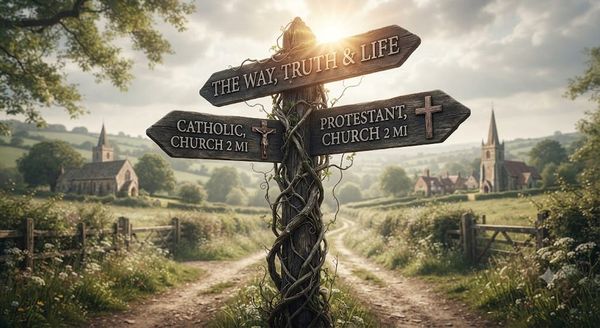
Faith Without Works Is Dead: What "Works" Really Means, and What It Does Not
A word study on the Greek behind James 2 and why he was talking about how you live, not what denomination you belong to.
Personally, I've heard many people argue "I believe therefore I'm saved!" but that can't be true because even the devil believes. Conversely, I've heard others say "Inorder to be saved you must be in our church and follow the doctrines X denomination has set forth since we are the the ones who brought you your bible." Neither of these are true (Note: I did a deep dive on the history of the church and the origin of the bible is shared across all denominations). So if neither is true, whats the answer? Well, understanding that as always requires looking at the Greek.
1. The Word Behind The Word "Works"
The Greek word James uses for "works" is ergon (ἔργον). Most English readers hear "works" and think of labor, tasks, or religious obligations. But the actual Greek tells a different story.
Strong's Concordance defines ergon as: work, deed, action, behavior, doing. The NASB translators, across all 169 uses of ergon in the New Testament, render it as action, behavior, deed, deeds, doing, labor, work, and works. Behavior is not a creative interpretation. It is one of the word's standard lexical meanings.
Greek has a separate word for hard labor: kopos, which means toil to the point of exhaustion. That is the word Jesus used when He promised rest for all who were weary and heavy laden in Matthew 11:28. Ergon is not that. Ergon simply refers to an action or task. It does not imply difficulty or burden. It is how you act, how you conduct yourself, how you live.
So before we even open James 2, the Greek is already telling us that James' usage of "works" is different than most people assume. It is not about checking boxes. It is about behavior.
2. James Tells You Exactly What He Means
James does not leave "works" undefined and open to interpretation. Six verses before "faith without works is dead" even begins, he tells you precisely what standard he is measuring against.
"If you really fulfill the royal law according to the Scripture, 'You shall love your neighbor as yourself,' you do well." James 2:8
That is a direct reference to Jesus' teaching in Matthew 22:39, where Jesus calls it the second greatest commandment. James calls it the "royal law," the law of the King of Kings, because it was endorsed by Jesus Himself. And then he builds the entire rest of the chapter on top of it, in one continuous argument.
“...but if you show partiality, you commit sin, and are convicted by the law as transgressors. For whoever shall keep the whole law, and yet stumble in one point, he is guilty of all. For He who said, “Do not commit adultery,” also said, “Do not murder.” Now if you do not commit adultery, but you do murder, you have become a transgressor of the law. So speak and so do as those who will be judged by the law of liberty. For judgment is without mercy to the one who has shown no mercy. Mercy triumphs over judgment. What does it profit, my brethren, if someone says he has faith but does not have works? Can faith save him? If a brother or sister is naked and destitute of daily food, and one of you says to them, “Depart in peace, be warmed and filled,” but you do not give them the things which are needed for the body, what does it profit?” James 2:9-16
Look at the statements being made:
- Verses 8-9: Love your neighbor as yourself, this is the royal law, and if you show partiality you sin against it.
- Verses 10-13: You cannot pick and choose which parts to keep. And mercy triumphs over judgment.
- Verses 14-16: What good is it if someone claims faith but has no works? If a brother is hungry and naked and you say "be warm and filled" but do nothing, what good is that?
The "works" James defines in verses 15-16, feeding the hungry, clothing the naked, are the direct application of the royal law he stated in verse 8. He is not introducing a new concept in verse 14. He is drawing a straight line from love your neighbor to faith without works. The works are the behavior that flows from that love. He told you what he meant before he even said it.
3. The Two Examples Prove It
James gives two examples of faith completed by works, deliberately chosen from opposite ends of the human spectrum to show that this is not about pedigree, status, or religious credentials.
In Verse 21-24 he discusses Abraham, the patriarch, the father of the faith. His "work" was obedience to God when asked to sacrifice Isaac. That is not a ritual. That is not a denominational tradition. That is not a ceremony performed in a specific building. That is trust made visible through action, at the deepest personal cost.
In verse 25 he mentions Rahab, the prostitute. Her "work" was hiding the spies and sending them out safely. She had no religious credentials. She was not part of the covenant community. She was a pagan woman acting on what she believed about God, at personal risk, with no institutional backing whatsoever.
"Do you see that faith was working together with his works, and by works faith was made perfect?" James 2:22
The word translated "working together with" is synergeo, meaning to work together with. Faith and behavior are not two separate things stacked on top of each other. They work together. Behavior is what faith looks like when it is breathing.
Notice what these examples share: both Abraham and Rahab responded directly to God. Neither of them was following a denominational rule. Neither was submitting to a religious authority's institutional requirements. Both were acting on what God placed in their hearts, and James holds them up as the definition of living faith.
4. Paul Uses A Completely Different Phrase
Here is where the confusion lives, and it dissolves the moment you look at the Greek. Both Paul and James use the same root word: ergon (ἔργον), plural erga (ἔργα). But Paul almost always qualifies it with a second word. His phrase is erga nomou (ἔργα νόμου), "works of the law." Baker's Evangelical Dictionary of Biblical Theology defines this phrase as denoting deeds prescribed by the Mosaic Law, (Romans 3:20, 3:27, 3:28, Galatians 2:16, 3:2, 3:5, and 3:10). At times Paul shortens the phrase and uses erga alone, but in context he is still referring to a mode of relationship to the Law set in contrast to faith in Christ.
James never uses this phrase. Not once. James uses erga by itself, unqualified, with no reference to the Mosaic system. That qualifier, nomou, is what changes the entire meaning. Paul is talking about a specific system of legal observance: circumcision, dietary codes, Sabbath rules, the ritual apparatus of the Mosaic covenant. He is fighting the idea that performing those rituals earns salvation. James is talking about feeding the hungry, protecting the vulnerable, and obeying God when it costs you everything. He is fighting the idea that you can claim faith and live as if it changes nothing.
Scholar Mark Nanos argues that Paul apparently invented the phrase erga nomou. It does not appear anywhere in prior Greek literature outside of Paul and the Dead Sea Scrolls. It is a technical term coined for a specific problem: Gentile converts being told they must become practicing Jews to be saved. A doctoral study on the phrase confirmed that Paul's use of ergon is ethically neutral, and the ethical orientation of a given "work" is determined by the descriptors Paul attaches to it. When Paul adds nomou, he makes it about legalistic performance. When James uses ergon alone, it means behavior flowing from faith.
Anyone who reads "faith without works is dead" and hears "works of the law" has conflated two different Greek phrases, aimed at two different problems, written by two different authors to two different audiences.
5. Two Authors, Two Problems, One Truth
Paul and James are not contradicting each other. They are guarding the same truth from opposite directions.
Paul fights legalism: people trying to earn salvation by performing rituals under the Mosaic system. His message is that no amount of rule-keeping saves you. Faith in Christ saves you.
James fights the opposite problem: people who heard Paul's message and concluded that since faith alone saves, behavior does not matter. His message is that if your faith does not change how you live, it was never real faith. Even the demons believe and shudder.
As one summary of the scholarship puts it: Paul was rooting out "works" that excluded and destroyed saving faith. James was stimulating a sluggish faith that minimized the results of saving faith in daily life. They stand back to back, confronting different enemies of the Gospel. Douglas Moo, whose Pillar commentary on James is rated the top in the field, makes the distinction explicitly: Paul's "works of the law" is different from James' "works." James is speaking of any good deed, while Paul has something specific in mind. And in James, the faith of those God has freely justified expresses its reality in obeying God.
Paul describes the root of salvation: faith. James describes the fruit: behavior that reflects it. They are two sides of one coin.
6. One Lawgiver, One Judge
Two chapters later, James makes explicit what was already implicit in his argument. He removes any ambiguity about who defines the works (behavior terms).
"There is one Lawgiver, who is able to save and to destroy. Who are you to judge another?" James 4:12
There is one Lawgiver. One. Not a denomination. Not a council. Not an institution. God. And Ligonier Ministries connects this directly back to the royal law in chapter 2: in violating the "royal law" of James 2:8, we claim that we know better how we must live than God does and thus judge His law as being false. When we add our own standards on top of God's, we make ourselves judges of the law rather than doers of it.
Now look at every example of "works" and ask: whose authority is each person obeying?
- The royal law (2:8): Jesus' commandment, not a denomination's rule.
- Feeding the hungry (2:15-16): God's intent for how we treat each other, not a church requirement.
- Abraham (2:21): obeyed God directly, not a priest, not a council.
- Rahab (2:25): acted on her faith in God at personal risk, with no institutional backing.
Not one of James' examples involves submitting to an earthly religious authority. Every single one involves a person responding directly to what God placed in their heart. The "works" that make faith alive are obedience to God's intent for our hearts, not compliance with a denomination's traditions. James himself makes this distinction, and then in 4:12 he makes it absolute: there is one Lawgiver, and it is not any of us.
7. What "Works" Is, And What It Is Not
Read "faith without works is dead" as "faith without (righteous) behavior is dead" and everything James writes clicks into place.
What it is:
Obeying under the moral compass He has given us since the beginning and iterated via the commandments. Living the way Christ asked us to live. Loving your neighbor as yourself. Feeding the hungry. Clothing the naked. Obeying God when it costs you everything. Taking risks for His purposes. Treating people the way Jesus treated them. Keeping sex inside of marriage. But most importantly, forgiving each other. Letting the royal law, the law of the King, show up in how you conduct your life every single day.
Remembering those that give mercy will receive mercy.
What it is not:
- Earning salvation through religious performance.
- Submitting to a denomination's institutional requirements.
- Obeying an earthly authority figure who claims to stand between you and God.
- Performing rituals prescribed by the Mosaic law or any human tradition layered on top of it.
- Checking boxes on a list that a church wrote.
James is not saying works save you. He is saying that if you are saved, your behavior will show it. The works are not the cause of your faith. They are the proof. A body without breath is a corpse. Faith without behavior is a corpse.
Not because the behavior earns anything, but because its absence proves the newed life was never real and that you never truly understood His teachings. The behavior changes show you realize what He was teaching and are actively applying it. Our actions have consequences, and each sinful action has a ripple effect that hurts others downstream.
"For as the body without the spirit is dead, so faith without works is dead also." James 2:26
The works James is describing are not a denomination's requirements. They are Christ's requirements.
"Jesus said to him, 'You shall love the LORD your God with all your heart, with all your soul, and with all your mind.' This is the first and great commandment. And the second is like it: 'You shall love your neighbor as yourself.' On these two commandments hang all the Law and the Prophets." Matthew 22:37-40
Love God. Love your neighbor. Let the world see it in how you live. That is what James meant by works. That is what Jesus asked of us. And it is simple enough for a child to understand.
"For Christ is the end of the law for righteousness to everyone who believes." Romans 10:4
"But I fear, lest somehow, as the serpent deceived Eve by his craftiness, so your minds may be corrupted from the simplicity that is in Christ." 2 Corinthians 11:3