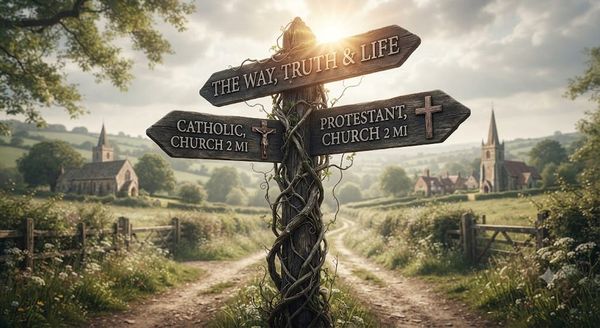
Why Don't Christians Follow The Old Testament Laws Anymore?
As a Christian, I can eat bacon and yes it makes sense
Why can we eat pork? Why can we wear polyester? Why do Christians ignore dozens of Old Testament commands while insisting the Bible is the Word of God?
These are fair questions, and they deserve a real answer. Not a hand wave, not "that was the Old Testament," but a reason grounded in what Scripture actually says about why those laws existed and what happened to them. And it turns out the answer is woven into a story we have already been telling.
The old covenant was a Marriage contract
If you have read the companion piece to this one, you already know that the old covenant was a marriage. God took Israel as His bride at Sinai, and the Law, all 613 commands, was the marriage contract. Every statute, every ordinance, every dietary restriction and fabric regulation and calendar requirement was a term of that specific covenant between God and one people.
That matters, because contracts belong to the marriages they govern. When the marriage reaches its lawful end, the contract does too. Paul says exactly this: "You also have become dead to the law through the body of Christ, that you may be married to another" (Romans 7:4, NKJV). The old contract ended when the Husband died. The new marriage runs on new terms.
I can hear the rebuttle "Oh yea, sure... but if God is perfect why have all those other laws and then change them? How do you even know whats relavant?" That's super fair but God always has a reason for what He does. So what were those laws for in the first place?
The wedding ring of the old covenant
The word underneath everything is קָדוֹשׁ qadosh, "set apart, holy." God tells Israel plainly why:
"And you shall be holy to Me, for I the LORD am holy, and have separated you from the peoples, that you should be Mine." (Leviticus 20:26, NKJV)
"That you should be Mine." That is marriage language. And every one of those laws functioned as a visible, daily marker that this people belonged to someone. You cannot sit down to eat without remembering whose you are. You cannot get dressed without remembering whose you are. You cannot plant a field without remembering whose you are. They were the wedding ring of the old covenant.
Take the fabric law. Leviticus 19:19 forbids wearing שַׁעַטְנֵז sha'atnez, a garment of mixed wool and linen. Why? Because as scholars have documented, that specific blend was reserved for the tabernacle curtains and the priestly garments (Exodus 26:1, 31; 28:6, 15; 39:29). Wool and linen woven together was holy fabric, set apart for God's dwelling and God's priests. Ordinary Israelites could not wear it because it belonged to sacred space. The Hebrew word כִּלְאַיִם kil'ayim, "forbidden mixtures," covered all of it, mixed fabrics, mixed seeds, mixed yoking of animals. Every prohibition was a boundary line reminding Israel that categories matter, that holy and common do not blend, and that this people was set apart from the nations the way linen was set apart from wool.
The food laws work the same way. The animals declared unclean in Leviticus 11 were not poisonous. They were markers. Every meal was a reminder: you eat differently because you belong to someone. The surrounding nations freely ate what Israel could not, and that was the point. The diet was a daily, physical, unavoidable sign of covenant identity. A wedding ring you could not take off, because you wore it in your stomach.
The guardian's discipline
There is a second layer, and it is the one Paul explains directly.
We have already seen that the Law functioned as a παιδαγωγός paidagogos, the household slave assigned to guard the heir until the father said the boy was ready (Galatians 3:24-25). What does a guardian do with a child? He controls what the child eats. He controls what the child wears. He controls where the child goes and who the child touches. Not because those rules are eternal in themselves, but because the child is not yet mature enough to govern himself.
That is exactly what the ceremonial laws were. They trained holiness into the muscle memory of a people who were not yet ready to walk by the Spirit. Every restricted food, every forbidden fabric, every calendar observance was the guardian saying: not yet. You are the heir, but you are not yet of age. These rules keep you on the path until the Father says it is time.
Paul names that endpoint plainly: "But after faith has come, we are no longer under a tutor" (Galatians 3:25, NKJV). The Liberalia came. The toga virilis went on. The guardian stepped aside. Not because the guardian was bad, but because the child grew up.
What the cross actually did to those laws
So when the Husband died and rose, two things happened to the ceremonial laws at once.
First, the contract they belonged to ended. Paul says it in Colossians:
"So let no one judge you in food or in drink, or regarding a festival or a new moon or sabbaths, which are a shadow of things to come, but the substance is of Christ" (Colossians 2:16-17, NKJV).
Food laws, drink laws, calendar laws, sabbath laws, all named, all called shadows. The body casting the shadow is Christ. Once He arrived, the shadow had done its job.
Second, the separation they enforced moved inside. Under the old covenant, holiness was external and you were set apart by what you ate, what you wore, who you touched, where you worshipped. Under the new covenant though, their holiness is internal.
"I will put My law in their minds, and write it on their hearts" (Jeremiah 31:33, NKJV; Hebrews 8:10).
The Spirit dwelling in the believer does what the dietary code and the fabric code used to do. He sets you apart from the inside out. You do not need a rule about what robe to wear because you wear the robe of a citizen. You do not need a rule about what meat to eat because your conscience is governed by the Spirit, not the menu.
What remains, and why
If the ceremonial laws ended with the old contract, why do some commands carry over? Because not everything in the old covenant was a contract term. Some things are descriptions of reality itself.
The Jerusalem Council in Acts 15 settled this for the early Church. When the question came up, "Do gentile believers need to follow the Law of Moses?", the apostles did not reimpose the food laws, the fabric laws, or the calendar. They gave four things:
"abstain from things polluted by idols, from sexual immorality, from things strangled, and from blood" (Acts 15:20, NKJV).
Those four are not arbitrary, and they are not a random sample of the old Law. They are the things that go back before Sinai, before the marriage contract was ever written. The blood prohibition traces to Noah (Genesis 9:4). Sexual immorality is a creation-order violation rooted in Genesis 2. Idol worship is spiritual adultery, a betrayal of the Creator that predates any covenant. These commands are not terms of the old marriage. They are the moral fabric underneath every covenant, old and new, because they reflect the character of God Himself.
The moral law persists because it was never just a contract term. It is a description of who God is. "You shall not murder" is not a Sinai invention. It is an eternal truth about the image of God in every human being (Genesis 9:6). "You shall not commit adultery" is not a cultural marker. It is a statement about the nature of covenant faithfulness that God Himself models. Marriage is between one woman and one man (Genesis 2:24). These survive the death of the Husband and the end of the old contract because they were never products of that contract in the first place.
One body, no shadow
So the next time someone asks, "Why do you eat pork but still say the Levitical Law is God's Word?", the answer is not complicated. The pork prohibition was a term of a specific marriage contract between God and Israel. That marriage reached its lawful end when the Husband died on the cross. The contract ended with it. The new marriage runs on new terms, written not on stone but on the heart, governed not by a guardian-slave but by the Spirit of the Son.
The shadow served its purpose. It pointed to the Christ. The Christ has arrived. In the next post, we go into what James meant when He said faith without works is dead (and what he didn't mean)
"But I fear, lest somehow, as the serpent deceived Eve by his craftiness, so your minds may be corrupted from the simplicity that is in Christ." 2 Corinthians 11:3
"At that time Jesus answered and said, "I thank You, Father, Lord of heaven and earth, that You have hidden these things from the wise and prudent and have revealed them to babes." Matthew 11:25
"He has shown you, O man, what is good; And what does the Lord require of you But to do justly, To love mercy, And to walk humbly with your God?" Micah 6:8
"For Christ is the end of the law for righteousness to everyone who believes." Romans 10:4