The Middle Ground Nobody Wants to Stand On
What the Pharisees and Sadducees Got Wrong Is What We Still Get Wrong
1. The Story That Sets the Table
If you’ve been reading my articles, you’d understand that I am neither a Catholic, an East Orthodox, nor a Protestant. I am a non-denominational follower of Christ who relentlessly seeks to unpack truth in a church that focuses on orthodoxy, built on studying both the Bible and church tradition. If you haven’t seen my church history timeline, I highly recommend starting there before proceeding through this.
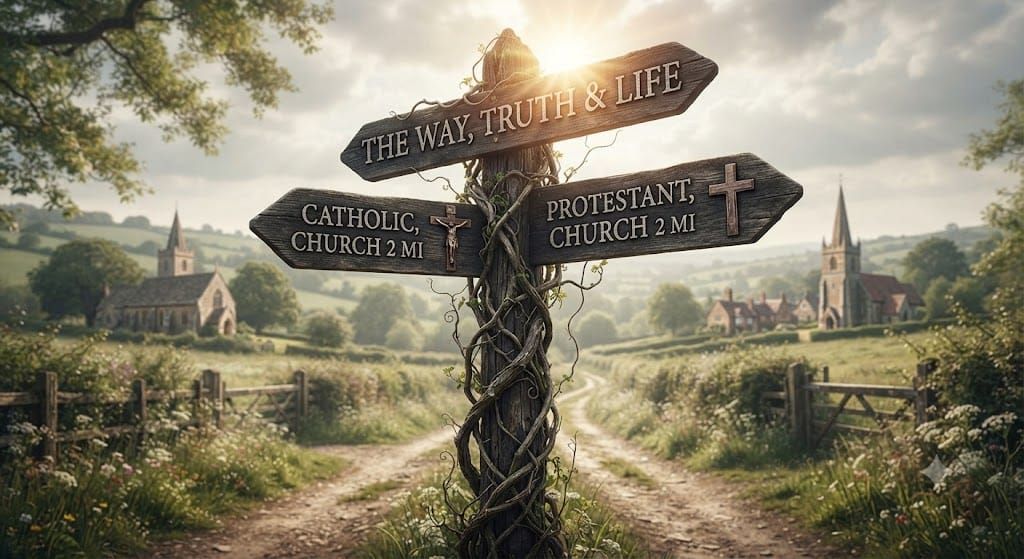
Now, that being said, the middle ground the title refers to is exactly right where I’m standing. Not someone who swears by Sola Scripture, and not someone who submits to the Roman Catholic Church's tradition, and I have very good reasons for both. But before we talk about that, I think we need to see the parallels of what has happened across history.
There is a well-known story in the Talmud (Shabbat 31a) that captures everything this article is about in a single scene. Chabad.org records it this way: a gentile approached Shammai, one of the leading Pharisees of his generation, and said he would convert to Judaism if Shammai could teach him the entire Torah while he stood on one foot. Shammai, insulted by the request, pushed him out of the house with a builder's cubit. The man did not give up. He went to Hillel, the other leading Pharisee of the era, and made the same request. Hillel converted him and said: "What is hateful to you, do not do to your neighbor. That is the whole Torah; the rest is the explanation of this. Go and study it."
Two Pharisees trained in the same tradition, the same Torah and the same oral law. One pushed the seeker away because the question did not meet his standard of seriousness. The other met the seeker exactly where he was, gave him the heart of the law in one sentence, and then told him to go learn the rest. Shammai guarded the gate and Hillel opened it. And the gentile walked through Hillel's door, not because Hillel lowered the standard, but because he understood that the PURPOSE of the standard was to bring people in, not keep them out.
That tension between guarding the gate and opening the door is the same tension that runs through every major divide in religious history. It ran through the Pharisees and the Sadducees in the first century. It runs through Catholics and Protestants today. And the lesson Jesus tried to teach about where the truth actually lives is the same lesson both sides keep missing, just from different directions.
2. The Ancient Divide: Pharisees and Sadducees
The Pharisees and Sadducees disagreed on something fundamental: whether the oral tradition carried the same authority as the written Torah. The Shalom Learning Center explains: "Even as the 613 laws of Moses were designed to interpret and contextually apply the Ten Commandments, at the time of Yeshua, the Pharisaic scholars were generating hundreds of oral laws intended to interpret and apply the 613, thus 'making a fence around the Torah' (Mishnah Aboth 1:1). Other Jewish parties (such as the Sadducees and Essenes) rejected this oral law."
The Sadducees held to the written Torah alone. If it was not in the text, it did not carry authority. Dave Armstrong on Patheos puts it bluntly: "The Sadducees were the ones who were the Jewish sola scripturists." They rejected the resurrection, the afterlife, and angelic beings (Acts 23:8) because they could not find sufficient proof for these in the written Torah alone.
The Pharisees, by contrast, believed that God gave Moses both a written Torah and an oral Torah on Sinai, and that the oral tradition was essential for understanding how to apply the written law to real life. Wikipedia confirms that the Mishnah (the written compilation of these oral traditions) arose because "Fearing that these events would lead to the oral traditions of the Second Temple period (516 BCE to 70 CE) being forgotten, Judah ha-Nasi compiled the Mishnah in its current form."
But even within the Pharisees, there were two competing schools. The academic paper on Mathematics of Family Planning in Talmud confirms: "Hillel was one of the most important Pharisee rabbis from the time before the destruction of the Second Temple in 70 AD. Shammai was a Jewish scholar of the 1st century and the most important contemporary of Hillel. In contrast to the mild Hillel, Shammai was considered strict and irritable in religious and ethical matters. In most cases, though not always, House of Hillel's opinion is the more lenient and tolerant than the House of Shammai's one."
So the landscape in the first century looked like this: the Sadducees held to the written text alone and rejected anything beyond it, the House of Shammai used oral tradition to build stricter fences around the law, and the House of Hillel used oral tradition to extend mercy and practical wisdom into situations the written text did not explicitly address. Sounds like sola scriptura vs tradition much? The same argument going on between the Catholics and the Protestants? Only the difference is where they sit. The protestants tend to be more lenient and tolerant, whereas the Catholics have become more strict.
3. Where Paul Stood
Paul was not a Sadducee. He was a Pharisee, trained in the oral tradition, under the most merciful school within that tradition.
"I am a Pharisee, the son of a Pharisee." Acts 23:6 (NKJV)
Reading Acts confirms: "Paul claims to be a Pharisee in Philippians 3 and when brought before the Sanhedrin Paul claims to have been 'educated at the feet of Gamaliel according to the strict manner of the law of our fathers' (Acts 22:3)." And: "Pharisees placed supreme importance on the Law and their own oral traditions and interpretations of the Law."
Gamaliel was the grandson of Hillel the Elder, the same Hillel who told the gentile "What is hateful to you, do not do to your neighbor. That is the whole Torah." Britannica confirms that Gamaliel "established a number of lenient ordinances, in particular, laws affecting women and non-Jews." The New World Encyclopedia adds: "Gamaliel ruled that the sabbath laws should be interpreted realistically rather than rigorously. He also argued that the law should protect women during divorce and urged Jews to be kind toward Gentiles."
Paul was trained by the grandson of the man who summarized the entire Torah as "love your neighbor," in a school known for interpreting the law with mercy and practical wisdom. That is not a footnote about Paul's background. That is the lens through which everything he wrote should be read. When Paul writes about marriage, divorce, remarriage, freedom for the abandoned spouse, and the gift of celibacy not being given to everyone, he is writing as a Pharisee from the House of Hillel, trained to apply the heart of the law to real human situations with mercy.
The Catholics tend to use Paul upholding oral traditions there reasoning for doing the same. I agree that CAN be a good idea, but there is nuance to oral tradition that it must be tested/measured through.
4. What Jesus Actually Rejected
Here is where the story gets uncomfortable for everyone, because Jesus did not align perfectly with any camp. He was not a Sadducee (He affirmed the resurrection, the afterlife, and angelic beings). He was not a Shammai-style Pharisee (He repeatedly challenged their strict oral traditions). And He was not simply a Hillel-style Pharisee either (He claimed an authority that transcended any rabbinic school).
But when Jesus rejected oral traditions (and he did often enough), there is a consistent pattern in which traditions He targeted. Every recorded confrontation involves traditions that either added burdens the written law did not require or created loopholes that undermined mercy.
Ritual handwashing (Matthew 15:1-2, Mark 7:1-5): The written law required priestly handwashing before Temple service. The Pharisees extended this to all people before all meals as a purity requirement. The Biblical Research Institute confirms: "The 'tradition of the elders' was a layer of oral Pharisaic teachings specifying how the law was to be kept under a multiplicity of circumstances and conditions. 'The rules in regard to purification were numberless.'" Jesus rejected the tradition that made the law MORE burdensome than God intended.
Corban (Matthew 15:3-6, Mark 7:9-13): The written law commanded "Honor your father and your mother" (Exodus 20:12). The Pharisees created a tradition called Corban that allowed a person to declare their possessions as dedicated to God, then continue using them personally while refusing to help their aging parents. Precept Austin confirms: "Moses had instructed God's people to 'honor their father and mother,' but the Pharisees negated that command by teaching that they could give money to the temple in lieu of helping their parents in need." Jesus rejected the tradition that created a LOOPHOLE to avoid compassion.
In both cases, Jesus' charge was the same: "You have a fine way of rejecting the commandment of God in order to establish your tradition!" (Mark 7:9 NKJV). He was not rejecting oral tradition as a concept. He was rejecting specific traditions that either piled strictness on top of mercy or manufactured technicalities to escape compassion. He never once rejected a tradition that extended mercy, protected the vulnerable, or preserved life.
5. The Modern Parallel Nobody Wants to See
Now again, look at the modern divide between Roman Catholics and Protestants and watch the ancient pattern repeat itself, but with the directions inverted.
Roman Catholics mirror the Pharisees structurally: they hold that Scripture and Tradition together form the deposit of faith, that the Church's teaching authority (the Magisterium) carries binding weight alongside the written text, and that the oral/traditional interpretations of the faith are essential for understanding how to apply Scripture to daily life. The Lonely Pilgrim explains: "Catholics found their doctrine on the union of Scripture and Tradition. Not only is this divergence an obstacle to agreement, it's even an obstacle to understanding."
Protestants mirror the Sadducees structurally: they hold to sola scriptura, Scripture alone as the final authority, and reject any tradition that claims equal authority with the written Word. Dave Armstrong again notes this parallel directly: "The Sadducees were the ones who were the Jewish sola scripturists."
But here is the twist that makes the parallel so striking. The DIRECTION of the outcome is inverted. The Pharisees used oral tradition to produce rulings like the mokh (a contraceptive barrier permitted for women whose health was endangered by pregnancy), and Mishnah Ohalot 7:6 (commanding that a fetus be dismembered to save the mother's life because "her life takes precedence over its life"). Tradition moved toward MERCY in the application of the law, preserving life where the written text was silent.
The Roman Catholic Church use tradition to make the law on marriage STRICTER than what the written text says: declaring marriage absolutely indissoluble where even Moses permitted divorce (Deuteronomy 24:1-4), eliminating Paul's explicit permission for the abandoned spouse to be free ("not under bondage," 1 Corinthians 7:15), and holding remarried believers in an ongoing state of adultery where Paul told the agamos (the previously married) that "it is better to marry than to burn with passion" (1 Corinthians 7:9 NKJV).
Meanwhile, the Sadducees used scripture-alone to be MORE liberal, rejecting the resurrection and the afterlife entirely (Acts 23:8). And Protestants used scripture-alone to be MORE merciful on remarriage, following Paul's actual words about freedom for the abandoned spouse and the permission for the previously married to remarry.
The structural positions are the same. The directional outcomes are reversed. The Pharisees used tradition to show mercy where the text was silent. The Catholic Church used tradition to add strictness where the text showed mercy. The Sadducees used scripture-alone to reject core beliefs. The Protestants used scripture-alone to reclaim the mercy the text actually teaches.
6. What Both Camps Get Wrong
The point is not that one side is right and the other is wrong as a whole. The point is that both sides make the same category of error, just from opposite directions, and it is the same error the Pharisees and Sadducees made two thousand years ago.
Protestants do not realize they need tradition to understand Scripture. Sola scriptura without historical context, original language study, and knowledge of how the earliest communities understood and applied the text leads to fragmentation, and frequently, too much leniency. There are tens of thousands of Protestant denominations precisely because everyone reads the same text and arrives at different conclusions. The written Torah was never designed to stand alone without interpretive guidance. That is why God gave the oral tradition alongside it, that is why Paul was trained in it, and that is why the Sadducees who rejected it ended up denying the resurrection, the afterlife, and angelic beings while claiming to follow the same Torah.
Roman Catholics do not realize they need Scripture to check tradition. More over, they need to understand the languages, those who wrote what they wrote, and the history of those like Paul who said what they said. When tradition produces rulings that are MORE strict than what the divinely inspired text (and Gods first children) actually says, when it traps the faithful spouse in bondage that Paul explicitly said they should be freed from, when it holds remarried believers in a state of ongoing adultery that Paul addressed with compassion and practical wisdom, then tradition has crossed the same line Jesus identified in Mark 7:9: rejecting the commandment of God to establish your tradition. The problem is not tradition itself. The problem is tradition that undermines the mercy the inspired text actually teaches.
This is not a new tension. It is the oldest tension in the story of God's people. Paul specifically called out the infighting between churches from nearly Day 1 (1 Corinthians 1:10-17). And Jesus addressed it not by siding with one camp over the other but by pointing both camps to the same place: the heart behind the law.
7. The Heart Behind The Law
Jesus quoted Hosea 6:6 twice. Once in Matthew 9:13: "But go and learn what this means: 'I desire mercy and not sacrifice.'" And again in Matthew 12:7: "But if you had known what this means, 'I desire mercy and not sacrifice,' you would not have condemned the guiltless" (NKJV).
He did not say "I desire tradition and not scripture." He did not say "I desire scripture and not tradition." He said, "I desire mercy." That is the measuring stick. Every tradition, every interpretation, every application of the law must be evaluated against the same question: does this move toward mercy or away from it? Does this protect the vulnerable or burden them? Does this open the door to the seeker or push them away with a builder's cubit?
When Hillel told the gentile, "What is hateful to you, do not do to your neighbor; that is the whole Torah, the rest is commentary, go and study it," he was not dismissing the rest of the Torah. He was giving the seeker the HEART of it first and then telling him to go learn the rest through that lens. The rest of the Torah is the explanation of what it means to love your neighbor. The traditions are the practical application of that love to daily life. And Scripture is the divinely inspired foundation on which everything stands.
You need the foundation. You need the traditions that apply it with mercy. You need the original languages that unlock the heart behind the words. And you need the courage to reject any tradition, however ancient, that produces outcomes less merciful than what the God-breathed text actually says. That is where Jesus was standing. It is the same ground Paul was trained to stand on under Gamaliel. And it is the ground that both Catholics and Protestants keep stepping off of, in opposite directions, for the same reasons the Pharisees and Sadducees stepped off of it two thousand years ago.
The question has never been "tradition or scripture." The question has always been "does this look like the heart of God?" And when Jesus encountered people who had that question wrong, whether they were strict Pharisees guarding the gate or Sadducees stripping the faith down to bare text, His correction was always the same: you are missing the mercy. Go and learn what that means.
Does this mean I think there aren’t Catholics that are saved or Protestants that aren’t saved? Hardly, I’m sure there are many in both groups that are just as there are many that are not. The question isn’t are you Catholic, Protestant, Orthodox. It’s do you love the Lord? Do you recognize Jesus as your Savior, your King, your Lord? Are you someone after God’s own heart like David that cares to understand Him, trying to learn to love more like him, so that you might better obey Him? Not a simple rule follower checking boxes, but someone who cares to conform to Him by learning to love more like Him?
"Give me understanding, and I shall keep Your law; Indeed, I shall observe it with my whole heart. Make me walk in the path of Your commandments, For I delight in it. Incline my heart to Your testimonies, And not to covetousness." Psalms 119:34-36 (NKJV)
"He has shown you, O man, what is good; And what does the Lord require of you But to do justly, To love mercy, And to walk humbly with your God?" Micah 6:8 (NKJV)